📚 Learn Quantum Computing
Master the fundamentals of quantum mechanics and computing with our interactive lessons, visual explanations, and hands-on quizzes designed for all skill levels.
🚀 Program in Development
Our comprehensive learning platform is currently under development. Join our waiting list to be notified when courses launch.
Choose Your Learning Path
Structured curricula designed to take you from beginner to expert
Beginner Path
Perfect for those with no quantum background. Learn the fundamentals step-by-step.
What You'll Learn
- What is Quantum Computing?
- Understanding Qubits
- Quantum Gates & Circuits
- Applications & Next Steps
Intermediate Path
Build on basics with advanced concepts and practical applications.
What You'll Learn
- Quantum Mechanics
- Quantum Algorithms I & II
- Error & Noise
- Capstone Project
Advanced Path
Dive deep into quantum algorithms and cutting-edge research.
What You'll Learn
- Advanced Theory
- Advanced Algorithms
- Error Correction
- Hardware
- Software Dev
- Research
Core Quantum Concepts
Build your understanding from the ground up with these essential modules
Quantum Superposition
Unlike classical bits that are either 0 or 1, quantum bits (qubits) can exist in multiple states simultaneously. This is like a coin spinning in the air - it's both heads AND tails until it lands.
Key Concepts
Quantum Entanglement
Entangled particles remain connected across any distance. When you measure one, you instantly know about the other - Einstein called this "spooky action at a distance."
Key Concepts
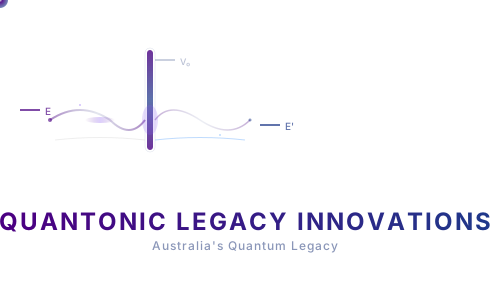
Quantum Tunneling
Particles can pass through barriers they shouldn't be able to cross classically. This phenomenon is essential for modern electronics and quantum computing operations.
Key Concepts
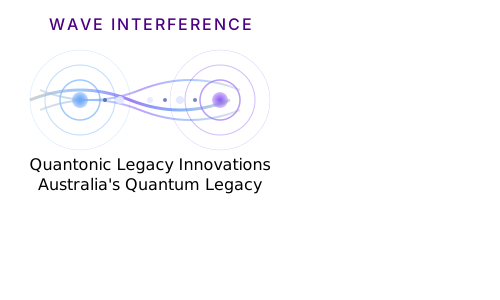
Wave Interference
Quantum particles exhibit wave-like behavior, creating interference patterns. This is the foundation of many quantum algorithms that exploit constructive and destructive interference.
Key Concepts
Quantum Fields
Quantum fields describe how particles interact and exchange information. Understanding fields is crucial for grasping how photonic quantum computers manipulate light.
Key Concepts
Quantum Bridge
Quantum bridges connect classical and quantum systems, enabling hybrid computing. This is how Quantonic's systems interface with standard computers.
Key Concepts
Learning Resources
Additional materials to supplement your quantum education
Why Learn with Quantonic?
Built on expertise, research, and innovation in quantum computing education
Academic Partnerships
Collaborating with leading universities to develop cutting-edge curriculum
Research-Backed
Content developed by quantum computing researchers and educators
Industry Standard
Curriculum aligned with quantum computing industry requirements
Hands-On Learning
Real quantum hardware access with Quantonic's desktop systems
Why Photonic Quantum Computing?
Quantonic uses photonic (light-based) quantum computing technology, which offers unique advantages for educational environments:
- Room-temperature operation - no expensive cryogenic cooling required
- Desktop-scale systems that fit in any classroom or lab
- Naturally low-noise environment for stable qubit operations
- Easy integration with existing fiber optic networks
- Scalable architecture for growing your quantum capabilities
📋 Test Your Knowledge
Put your quantum understanding to the test with our interactive quizzes
Light Computer Challenge
Can you figure out which jobs are perfect for a Light Computer (quantum) and which are better for a
Start Quiz →Quantum Basics for Kids
Test what you learned about quantum computers with this fun quiz!
Start Quiz →Quantum Adventure
Join Dr. Qubit on an interactive journey through the quantum realm! Make choices and learn as you go
Start Quiz →Quantum Foundations Quiz
Test your understanding of quantum computing fundamentals - superposition, entanglement, and quantum
Start Quiz →Ready for Hands-On Learning?
Experience real quantum computing with Quantonic's desktop systems designed for education.